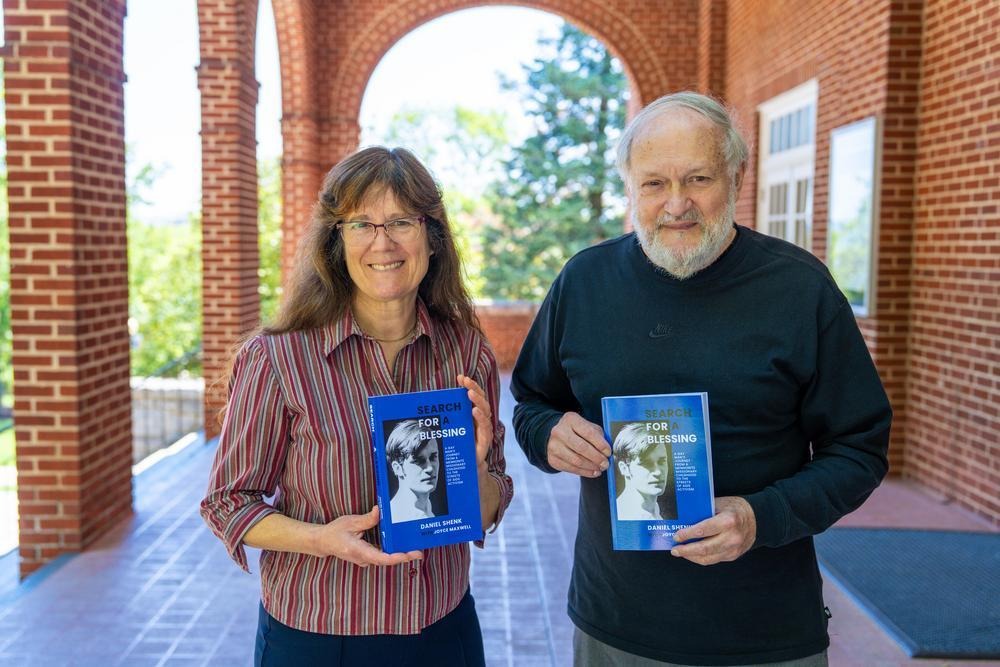
Co-authored by Joyce Shenk Maxwell ’85, “‘Search for a Blessing’ is a reflective, inspirational story of a gay son of evangelicals finding a place for himself in the world” ()
Joyce Shenk Maxwell ’85 had heard from family members that her uncle, Daniel Shenk ’71, was a gifted storyteller. When the world went into lockdown during the COVID-19 pandemic, she began collecting stories from his life over phone calls, recording and transcribing their conversations, and sending them back to him to review. Somewhere along the way, those stories became the beginnings of a memoir, co-authored by the two of them and published by Pandora Press in April.
The memoir, Search for a Blessing: A Gay Man’s Journey from a Mennonite Missionary Childhood to the Streets of AIDS Activism, recounts his earliest memories growing up as the son of Mennonite missionaries in East Africa and going to boarding school at age six, and reflects on his life’s work responding to the AIDS crisis in New York City during the 1980s and ’90s.
“As gay men are growing sick and dying from an illness that no one yet understands, Shenk becomes a chaplain for the disenfranchised and a founding member of Bailey House, a residence for people with AIDS,” a description reads. “This memoir is also a story of family, as Shenk grapples with a demanding father and struggles to relate to his uncomprehending siblings.”
A book launch at , 76 W. Gay St., in Harrisonburg this Sunday, May 17, at 2 p.m. will feature a reading, Q&A, and book signing with Shenk and Maxwell. People can purchase a copy of the book at the event or email Maxwell for one at joyce.maxwell1@verizon.net.
Finding his calling
Shenk’s formative experiences at EMU and his relationships with faculty who supported and mentored him sparked a passion for advocacy work.
After a year at Pace University in New York City, the Lancaster Mennonite High School grad transferred to EMU, where he studied sociology and became involved in student government and the Peace Club. “We were the activists on campus at the time, in the early ’70s,” he said. “We were going off to Washington D.C. for anti-Vietnam War protests, and I was deeply involved in that.”
The summer between his junior and senior years at EMU, Shenk served as an assistant chaplain at a prison in Southampton County, Virginia. There, he gained insight through interviews with inmates and discovered a growing empathy for them and other marginalized communities. He said the late professor Grant Stoltzfus, who taught church history at EMU for 17 years, was a major influence on his life. “He was extremely supportive of my interest in corrections,” Shenk said. “He drove the whole way down to see me, a three- to four-hour drive.”
After graduating from EMU, Shenk continued his work as a prison chaplain and then returned to New York City, where he worked with clergy serving in city-run hospitals through the Council of Churches. “They were coming into contact with this new, mysterious disease,” he said. “That’s sort of what put me in touch with AIDS at the very beginning, relating to these chaplains who were encountering it.”
Shenk was a founding member of Bailey House, which provides housing and supportive care for people living with HIV/AIDS and other chronic illnesses. He also helped form the AIDS Resource Center, which advocated for supportive and pastoral care for people with HIV/AIDS.
He graduated from Union Theological Seminary and was ordained at Judson Memorial Church, which is affiliated with the American Baptist Church and the United Church of Christ.
Maxwell, a writer and editor of biographies, also credited her EMU education with giving her the skills and values she needed. She majored in home economics education, and said the arts and design emphasis of the program helped her develop a career in publications and layout. “EMU was formative in my writing,” she said. “Those aspects of maturation where you learn to be coherent and cohesive in how you communicate certainly happened at EMU.”
Their EMU family connections run deep. Shenk’s brother and Maxwell’s father, the late Joseph Shenk, was an Eastern Mennonite Seminary alumnus who served as campus pastor and international student advisor at EMU, and later as co-pastor of Weavers Mennonite Church in Harrisonburg. Another of Maxwell’s uncles, the late Omar Eby, was professor emeritus of English who taught at EMU for nearly 30 years.
Shenk retired and moved back to Virginia in 2023. He now lives at Virginia Mennonite Retirement Community, near his niece and other family members.
‘A very real story’
Shenk said his goal for the book is not only to tell the story of what it was like to be a gay man in New York City during the early years of the AIDS epidemic, but also to share a message of God’s love and to humanize LGBTQ+ people. “I hope it helps people become more open to their lives,” he said.
In his praise for the book, historian and author John L. Ruth writes that, while “avoiding the tone of any official echo chamber, Dan Shenk offers a non-defensively candid explanation of the unlikely arc of his spiritual pilgrimage.”
“And I think he caught a little bit of the tone of the book,” Maxwell said. “It’s not a triumphal book in any sense. It’s not a raised-fist kind of book. It’s really somebody who’s grappling with being authentic and being true to themselves.”
“I think there’s a place for stories that are based in hurt and alienation,” she added. “It’s a very real story that a lot of people can relate to, because all of us have been hurt in one way or another and are trying to understand how to find healing and wholeness in the midst of that.”
For more information about the book, visit .
Read other reviews of the book:
A wonderful book from a wonderful friend! I’ve known Dan ever since we went to Lancaster Mennonite High School and EMU together and I know first-hand what a person of honesty and integrity he is. I’d already been familiar with some of the material in the book but I’m so glad his experiences have been recorded for a wider audience. It really is a great chronicle of a profound spiritual journey. I hope the book will get a wide readership! And take time to savor it as you read through it. I guarantee you’ll be enriched. Thank you, Bro. Dan!
Thank you, Dan and Joyce, for writing this really beautiful and inspirational memoir. As you know, as Mennonites, and many other denominations, being serious about the ethics of inclusion, the call to love my neighbor, to not think “us and them”, has been profoundly tested these last few years. And we are not yet there!
To testify to the grace of those called to be patient and forgiving, while also ministering with the compassion of Jesus, is a model for the Church. We contiyto pray for light!
Blessings,
John (Phil) Esau
Uncle to Christine Kaufman-Shenk
This is a profoundly moving, deeply vulnerable, and incredibly significant piece. Daniel Shenk’s memoir, *Search for a Blessing: A Gay Man’s Journey from a Mennonite Missionary Childhood to the Streets of AIDS Activism*, hits right at the messy, painful intersections of faith, family, sexuality, and systemic marginalization.
What makes this story carry so much weight is its raw authenticity and the distinct absence of a defensive or triumphalist tone. Instead of a “raised-fist” narrative, it’s a candid look at a human being actively grappling with identity and alienation while remaining deeply committed to a spiritual pilgrimage. Moving from a demanding, evangelical missionary childhood in East Africa to serving as a prison chaplain, and ultimately stepping onto the front lines of the terrifying early days of the NYC AIDS epidemic as a founding member of Bailey House, is an astonishingly unique life arc.
It stands as an essential, healing testament for anyone who has ever felt pushed to the margins of their own community—proving that walking away from institutional rigidness doesn’t mean walking away from God’s love, but can instead expand your capacity for genuine empathy and systemic care.