
Last month shaped up to be a memorable one for EMU Professor Steven Johnson.
In early October, the conservation photographer traveled to London for an awards ceremony honoring him among The annual competition, hosted by the Natural History Museum, selected his photo 鈥淧ool of Wonder鈥� and 99 others for inclusion in the exhibition. A jury of nature photography experts picked the 100 winning images out of 49,957 entries from photographers in 95 countries.
That means Johnson鈥檚 photo was part of only 0.2 percent of submissions to receive the coveted award. It鈥檚 not hard to see why the contest has been described as 鈥渙ne of the most prestigious in world photography鈥� ().
Johnson networked with skilled photographers from around the world, including some up-and-coming talents in the youth category, at the ceremony. He and his wife, Anna Maria, explored the museum and admired the other winning photos.
When he returned home from the trip, he searched online to see which news outlets had covered the event. It was then he saw that among their 13 favorites from the competition.
鈥楽omething a little special鈥�
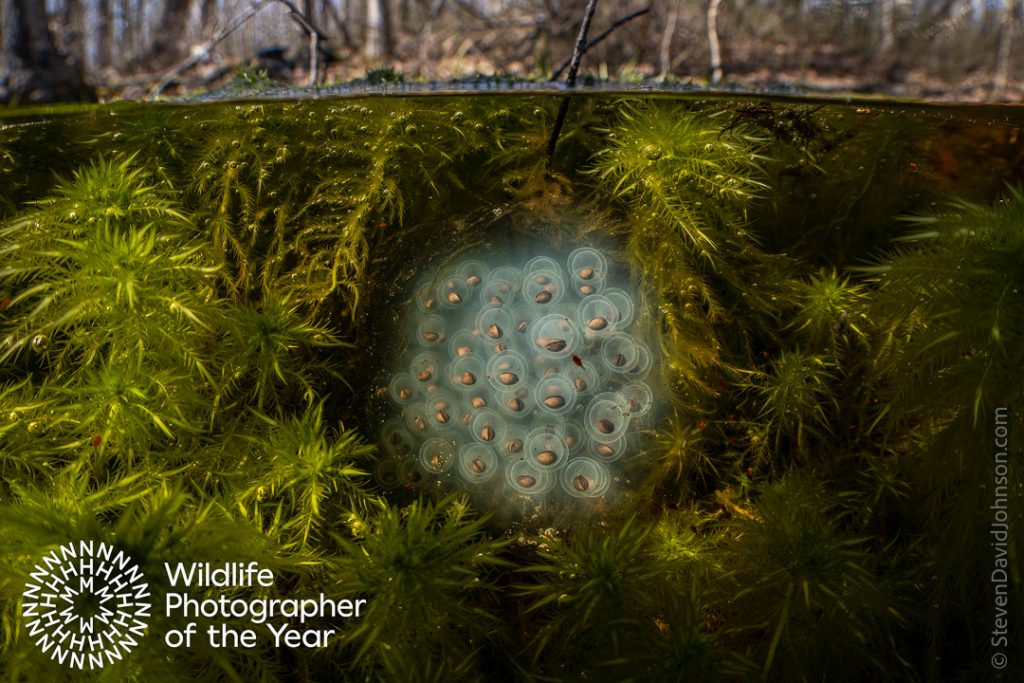
鈥淧ool of Wonder鈥� captures a cluster of spotted salamander eggs nestled on a bed of sphagnum moss just under the surface of a vernal pool in Augusta County, Virginia.
Vernal pools are temporary bodies of water that form from seasonal rains and snowmelt, Johnson writes on his . In late winter and early spring, the pools host breeding events for amphibians and macroinvertebrates. The pools are ideal nurseries for salamanders because they鈥檙e safe from predators such as fish.
鈥淎s a conservation photographer, I鈥檓 drawn to the intricate dance of underwater life in Appalachian Mountain forests and nearby lowlands,鈥� he states on his website.
Johnson, professor and program director for the visual and communication arts (VaCA) department, created the photo in March 2020 during a sabbatical. Taking good pictures of vernal pools requires being there at the right time and a lot of searching, he said. The vernal pool featured in 鈥淧ool of Wonder鈥� is on land owned by a friend who serves with him on the Virginia Wilderness Committee.
Johnson used a camera rig capable of being submerged underwater to capture the split between the sparse brush seen above the surface and the lush vegetation below.
鈥淭he light was beautiful, and it鈥檚 really just a few inches of water, so I鈥檓 just kind of crouched by the side slowly lowering my camera in to try to not disturb the sediment around it,鈥� he said, recalling the moment he took the photo.
鈥淧ool of Wonder鈥� graced the cover of the summer 2021 issue of Nature Conservancy magazine. Johnson has previously likened the sunlight filtering through the eggs in the picture, and the delicate shades of blue and green, to 鈥渁n aquatic Vermeer painting鈥� (EMU News).
He entered the wildlife photography contest for his first time this year after some encouragement from friends in the field.
鈥淭his one always felt like it had something a little special to it,鈥� he said. 鈥淚 think the sort of symmetry, the color, it all felt like something had come together in that image.鈥�
Johnson, who authored an with featured essays by vernal pools expert Michael Hayslett, said part of his mission as a conservation photographer is to highlight the threat that development and climate change pose to the underwater worlds.
Less predictable spring rains are causing pools to dry up before the young salamanders can fully develop and live on land.
鈥淸Hayslett] has told me that living here for decades, there used to be one big night where you could predict all the spotted salamanders would come out and migrate, and now that鈥檚 become very fragmented to much smaller events,鈥� he said.

Where art meets science
When he鈥檚 not crouching by the side of a vernal pool in his waders, Johnson is teaching the next generation of photographers and visual artists.
In addition to conservation photography, his courses include advanced Photoshop, web design and social media. Johnson said the VaCA program teaches students about different forms of storytelling, from web and video production to animation and photography, and even painted murals.
鈥淪tudents really get that full scope,鈥� he said. 鈥淚 think that is what makes them so marketable. They know how to do a whole bunch of things and do them well.鈥�
鈥�19 is putting the skills he learned from those classes to good use as media producer at Gravity Group, a Harrisonburg-based brand and marketing consultancy. He said the class in conservation photography instilled in him a love for nature photography. It not only taught him technical skills, but also how to be more intentional with the stories he tells.
Swartzendruber described 鈥淧ool of Wonder鈥� as visually stunning.
鈥淚t truly brings me to an entirely different world just looking at it,鈥� he said.
鈥淗e鈥檚 doing something that I鈥檝e genuinely never seen before with the knowledge he has.鈥�
Johnson is now in his 19th year at EMU. He said one unique strength for the VaCA program is the wealth of places to photograph nature near campus, such as the 1.6 million acre . The cameras they use in their courses, even at the introductory level, are the same ones he uses professionally, he added.

He welcomes students approaching his visual and communication arts classes from a background in environmental science and biology.
鈥淚f they love the world of nature, the environment and also want to communicate about that, we have two dedicated courses right now they can develop those skills and find faculty who are passionate about that intersection,鈥� Johnson said.
One new class he鈥檒l be co-teaching in the spring with Professor Steve Cessna is Communication and the Environment. The class will teach students how scientists and advocacy nonprofits communicate about science and the environment, what kinds of strategies they use and will give students a chance to try it themselves.
Professor Tara Kishbaugh, dean of EMU鈥檚 School of Sciences, Engineering, Arts and Nursing, said Johnson exemplifies the value of a liberal arts education in reflecting the importance of communication skills and multidisciplinary work.
“Steven’s focus on communication of conservation needs aligns well with our science programs, particularly those in environmental science, and is one of many reasons why I am happy to have the arts within my school,” Kishbaugh said. “EMU students, both within and outside the arts programs, can benefit from Steven’s expertise and his thoughtful way of living out his values in his teaching and his art.”
Amazing! Congratulations Steve!
Congratulations, Mr. Johnson! I was first alerted to your work through the EMU Weekly Digest and have subsequently enjoyed viewing your remarkable portfolio over the years, including online pictures and local exhibitions. I have downloaded your book and was pleased to see you featured in a documentary on vernal pools. Congratulations on your latest award. I am delighted to see you recognized for your outstanding work!
Congratulations, Steven, on a well-deserved award.
Congratulations, Steve! Absolutely stunning work!
EMU students are very fortunate to have the opportunity to learn with you and from you. Congratulations on the recognition!
Such a great intersection of science and art. Congratulations, Steve!
What a well-deserved honor, Steve! EMU is so fortunate to have you on the faculty, and most fortunate of all are the hundreds of students you have taught.
Nice post great info
Thank you Steve Johnson may you work continue to inspire students and people whom you interact with. Blessings to you and the family.
Thank you, Thomas! We miss seeing you around Harrisonburg. I hope you and your family are doing well.