
The fruit trees aren鈥檛 budding on the hill and the bees aren鈥檛 buzzing around their hives as 草莓社区 (EMU) settles into winter 2013 in the Shenandoah Valley of Virginia.
But EMU has tilled its soil for a flourishing 鈥渆dible campus鈥� in the spring.
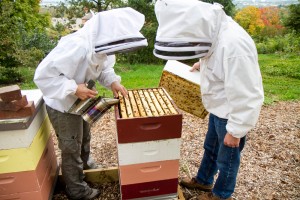
Springtime visitors can expect to stroll by asparagus hedges on their way to the tennis courts. They鈥檒l circumvent the compost pile and chicken house-on-wheels by the soccer field. And they鈥檒l need to avoid disturbing the four beehives near a popular hilltop meeting room.
Situated on the western edge of the small city of Harrisonburg, Va. 鈥� often overshadowed by nearby James Madison University with 10 times the student population 鈥� EMU is gradually gaining a small measure of fame for its devotion to what it calls 鈥渃reation care.鈥�
鈥淐aring for God鈥檚 creation鈥� started in 1976-77 at EMU when a science professor opted to spend his sabbatical year studying the ways the college could cut fuel consumption. He succeeded. Among other steps, EMU launched into energy-efficient construction, with new buildings heated and cooled by a unique closed-loop system in the 1980s. In the fall of 2010 EMU became the host of what was then the .
1,000 Edible Plants on 100 Acres
In 2011, by sprinkling 1,000 food-producing plants around the 100-acre campus.
鈥淭his started because students saw 鈥楩ood Inc.鈥� [a 2008 documentary, critiquing agribusiness] and began knocking on my door saying, 鈥楬ey, we want to grow food on campus,鈥欌�� said , grounds supervisor at EMU.
The students found receptive ears 鈥� Hairston has a degree in horticulture from Virginia Tech. Yet, in his 20 years at EMU, Hairston had mainly focused on planting ornamentals, believing their beauty to be 鈥渇ood for the soul.鈥�
Suddenly Hairston found himself running to keep 鈥渏ust a half step ahead of the students,鈥� who were pointing out the beauty of lettuce and acorn squash and persimmon trees.
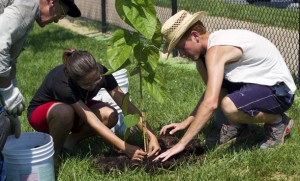
Students, joined by a handful of faculty members, began raising vegetables in three large garden areas on campus. They now sell their produce, when in season, on Saturday mornings near the University Commons. They also give the campus community the option of harvesting their own produce, asking only that harvesters contribute back by weeding or otherwise helping out.
Apple and pear saplings now dot the western hill that backs EMU. 鈥淧runing the trees has been my baby,鈥� said senior Alyshia Zimmerman.
Seminary professor donated four bee hives and is mentoring聽 Tessa Gerberich, an undergraduate student, in bee care.
Zimmerman, who is plotting EMU鈥檚 edible plants on a master map, pointed to other locations of fruit-bearing trees on campus 颅鈥� fig, plum, persimmon, paw paw, and hazelnut trees can be found near sports fields. Alert campus strollers will spot grape vines and bushes bearing cornelian cherries and raspberries. 鈥淲e want to raise awareness to the availability and health benefits that these plants can provide,鈥� she said.
Resurrecting Farm Skills
Students walking to the quad of , with dual-flush, low-flow toilets, recycled bricks, solar panels that preheat water, and so forth聽 鈥� pass asparagus plants that look yummy but shouldn’t be harvested until year two or later.
In June 2012, began collecting the runoff from the buildings, roads and parking lots covering 15 acres at EMU. It is now used for watering the grass on four sports fields and other vegetation, including the edible landscaping.
Chickens lay eggs in enclosures behind the science building, not far from a compost heap where the leftovers from the main dining hall eventually turn into soil to nourish the campus vegetable and herb gardens. Much of the produce in these gardens returns to the serving lines of the dining room. The campus chef steps outside her industrial kitchen to pluck basil, cilantro, dill, oregano, parsley, rosemary, thyme and sage.
鈥淎ctually being 鈥榞reen鈥� and living in environmentally sustainable ways feels to many of us like returning to the frugality and healthy farming practices of our forebears,鈥� says , who was raised in the Mennonite-thick farm community of Kalona, Iowa.
Long-Term Benefits
In September 2012, Swartzendruber began a three-year term on the board of directors of the , whose mission is 鈥渢o equip, inspire, disciple and mobilize God鈥檚 people in their effort to care for God鈥檚 creation.鈥�
This is a group that does not question the view of the majority of the world鈥檚 scientists that climate change is occurring and that, left unchecked, will have serious consequences for all forms of life as we know it.
鈥淏y tradition and current practice, EMU aims to make decisions that are right in the long term,鈥� says Swartzendruber. 鈥淲e can鈥檛 always see the immediate pay-offs, but we feel we are stewards of the environment in which we all live. The benefits of making the right decisions may accrue to others, or to our descendants, but they are benefits nonetheless.鈥�
“The cistern at EMU, for instance, may reduce the amount EMU pays for using city聽water by up to $4,000 annually. But considering that the cost of the project is聽nearly $100,000 (with about half the cost covered by a grant from the National Fish聽and Wildlife Federation’s Chesapeake Bay Stewardship Fund), EMU didn’t build the聽cistern to save money in the short term.”
It was built it in part to enhance the health of the trees and stream in a small park owned by the university. The stream connects with waterways that flow into the Chesapeake Bay. So protecting the feeder stream ultimately contributes to the health of the Bay.
So If You Visit . . .
Back to being a campus visitor. . . Here鈥檚 a hint at the subtle differences you might notice. Let鈥檚 just say a rickshaw driver from India would look at home on this campus 鈥� not too different from the EMU employee with muscular calves pedaling a bike hitched to a long cart bearing storage containers. This is the way the recycling bins around campus are serviced. No fossil fuels.
No, no, these Mennonites do not drive horse-drawn buggies. They are modern Mennonites. In fact, half of the campus community isn鈥檛 Mennonite at all. But everyone here tends to walk a lot and ride bikes 鈥� not because they don鈥檛 have drivers鈥� licenses, but because they believe it is good for the environment and their personal health. 颅颅颅
As an example, the undergraduate academic dean 颅颅鈥� who has close-cropped hair and often wears slacks 鈥� hasn鈥檛 driven the one-and-a-half miles from her home to campus in four years. She walks, bikes, or takes public transportation.
Sure, if you look closely, you can find a woman who sticks to below-the-knee skirts and who wears a prayer cover on her hair. But look more closely, and you鈥檒l see that this woman is the 76-year-old historical librarian who logged nearly 400 miles on her recreational bike between May and September. And who loves to backpack in .
This campus community doesn鈥檛 lend itself to stereotypes. But it does lend itself to great eating.
I was only able to briefly visit the campus when I came home for Christmas, but I was thrilled with what I did see. Publications like this not only raise awareness on campus- but they are hopefully giving ideas to other institutions locally, and nationwide.
When will the fruit be ready?
Most of the fruit trees are saplings — I mean, the edible campus effort is fairly new! But you can probably find some plums to pick when the growing season returns. And, of course, the vegetable gardens will be producing by summertime, and you’ll likely find some strawberries there . . .
Last year, the saplings tried to produce some fruit, but they were still too young and I cut off the fruit so that they could focus on their roots. This past year, the trees have grown amazingly strong and have sturdy, thick trunks. I think some of them are ready to start producing a little fruit in this coming year :)
We should look at planting a row or two of grapes at the top of the hill… that would be sweet
Also, a correction to this article. Kenton Derstine is mentoring Tessa Gerberich in bee keeping, and that is most likely Tessa with Kenton in the photo. I did help prepare a place for the bees, but the bulk of the care and drive came from Tessa.
Wonderful article ! Don’t forget the fig trees by the science center greenhouse/backlot! :)
Aly: I corrected the error of identification that you called our attention to. Thanks for letting me know!