
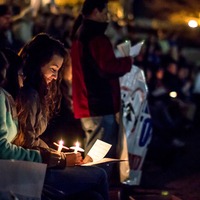
About a hundred people gathered at a candlelight vigil this week on the 草莓社区 (EMU) campus to show their support for Mennonite pastor Max Villatoro.
In the center of Thomas Plaza, burning candles were placed on a pile of ice. A nearby sign proclaimed the vigil鈥檚 theme: 鈥淢elt ICE,鈥� a reference to the unrelenting, and some would say, disturbing policies of U.S. Immigration and Customs Enforcement that have recently separated Villatoro from his family.
A Honduran native who has lived without citizenship in the United States since the early 1990s, Villatoro was detained on March 3 by U.S. Immigration and Customs Enforcement (ICE) and deported last week [March 27].
Despite a past criminal record of two misdemeanor charges, supporters say Villatoro had changed his life, becoming a Christian and devoting himself to his family and his congregation. According to supporters, he would be an appropriate candidate for the reprieve offered by President Barack Obama鈥檚 deportation policy if an immigrant does not jeopardize national security or public safety.
‘Pastor Max’ known among EMU students
Two student organizers of the vigil, senior Aliese Gingerich and junior Rachel Schrock, are among many in the EMU community who have a strong connection to Villatoro. He is a co-pastor, with his wife, Gloria, of Iglesia Menonita Torre Fuerte, a small Hispanic congregation based at in Iowa City, Iowa. Gingerich and Schrock attend First Mennonite Church.
Villatoro 鈥渨as someone who cared about the space and the people in it,鈥� said Schrock. 鈥淗e would ask you how you鈥檙e doing, and he would really listen. He cared about people, and he was a strong presence in the church.鈥�
Gingerich, who spent this last summer working with Villatoro, mentioned the anxiety she felt for him during that time. Villatoro made no secret of his lack of citizenship, even in which he recounted his story of moving to the United States for a better life, meeting his wife, and starting a family. He and Gloria have four children, all U.S. citizens. Gloria, who is from Mexico, is living legally in the United States under the Deferred Action for Childhood Arrivals, according to the Iowa City Press-Citizen.
Schrock鈥檚 fear was realized when she was on a in Georgia, learning about issues that immigrants face in the United States. Ironically, she, along with sophomore Diego Barahona, were visiting a detention center when they learned the news.
Barahona, also a Honduran native, spoke at the vigil in English, with his remarks translated into Spanish. He expressed appreciation for the Mennonite community and their strong support of Villatoro.
Several protests and vigils have taken place over the past several weeks. Congregations in the Central Plains Mennonite Conference 鈥� the conference in which Villatoro鈥檚 church belongs 鈥� have actively showed their support for Villatoro and his family. The conference collected more than 40,000 signatures, including 8,000 from clergy members, from around the United States. Those documents were delivered to the ICE office in Omaha, Nebraska, just one week after Villatoro鈥檚 detention. The conference has also started a .
Immigration and Customs Enforcement determined the grounds for Villatoro鈥檚 deportation by citing his criminal record 鈥� a drunk-driving conviction in 1998 and record tampering, after purchasing a Social Security number in order to get a driver鈥檚 license, in 1999. Villatoro has since had a clean record and according to media sources, was unsuccessful in appealing a past deportation order.
Common ground with vigil supporters
In his speech, Barahona also addressed the plight of child immigrants, recalling his arrival in the United States at age 4 and a childhood visit to Walt Disney World, seemingly a paradise at the time.
鈥淚n contrast,鈥� Barahona told the assembled crowd, 鈥渢ens of thousands of child immigrants were not received by a magical kingdom. They were received by a kingdom that supposedly stands for the liberty of the oppressed, but hesitates to take in the youngest victims of the conflict they help create.鈥�
Hannah Mack-Boll, a junior, who works at in Harrisonburg, said she appreciated the 鈥減oignance鈥� of Barahona鈥檚 speech. She hears many stories similar to Villatoro鈥檚, and remarked on how helpful it is that 鈥渨e can now gather together to understand the importance of Villatoro鈥檚 story in the context of a broader issue.鈥�
鈥淚t was encouraging to see such a strong turnout of students, faculty and staff to express our solidarity with Pastor Max and others who have been separated from their families,鈥� said EMU president Loren Swartzendruber, one of at least two university administrators to attend the vigil. 鈥淭he stories shared by several immigrants were important for all of us to hear.鈥�
Getting the word out about that story and rallying support has been one of Gingerich鈥檚 recent concerns. She spent two days before the vigil passing out 380 Spanish-language flyers to local organizations, businesses, clinics, grocery stores, and even taco trucks. She wanted to the community to be involved, and to provide a space for healing and reflection.
鈥淢ax鈥檚 story is a platform for all the other stories like his that don鈥檛 get coverage,鈥� Schrock said.
It will be extremely difficult and complicated for Villatoro to regain entry to the United States, according to his attorney.